
Built on Trust. Driven by a Stronger Tomorrow.
Gabion SystemGABTEC Gabion Systems are modular, flexible and permeable structures made of double-twisted hexagonal wire mesh filled with natural stone. Unlike rigid concrete or masonry walls, their open structure lets water pass freely through — relieving the hydrostatic pressure that is a leading cause of retaining wall failure — while the mesh itself tolerates ground movement and differential settlement without cracking.
They are designed to provide long-lasting, cost-effective and environmentally friendly solutions for a wide range of civil and environmental engineering applications, with a typical design life of 50–100 years.


One material system, four different jobs. Each variant below is built from the same double-twist hexagonal mesh — what changes is the shape, and what that shape is for.
A box with an integral mesh "tail" that reinforces compacted soil fill.
See details ↓A wide, shallow panel that armours channels and slopes against erosion.
See details ↓
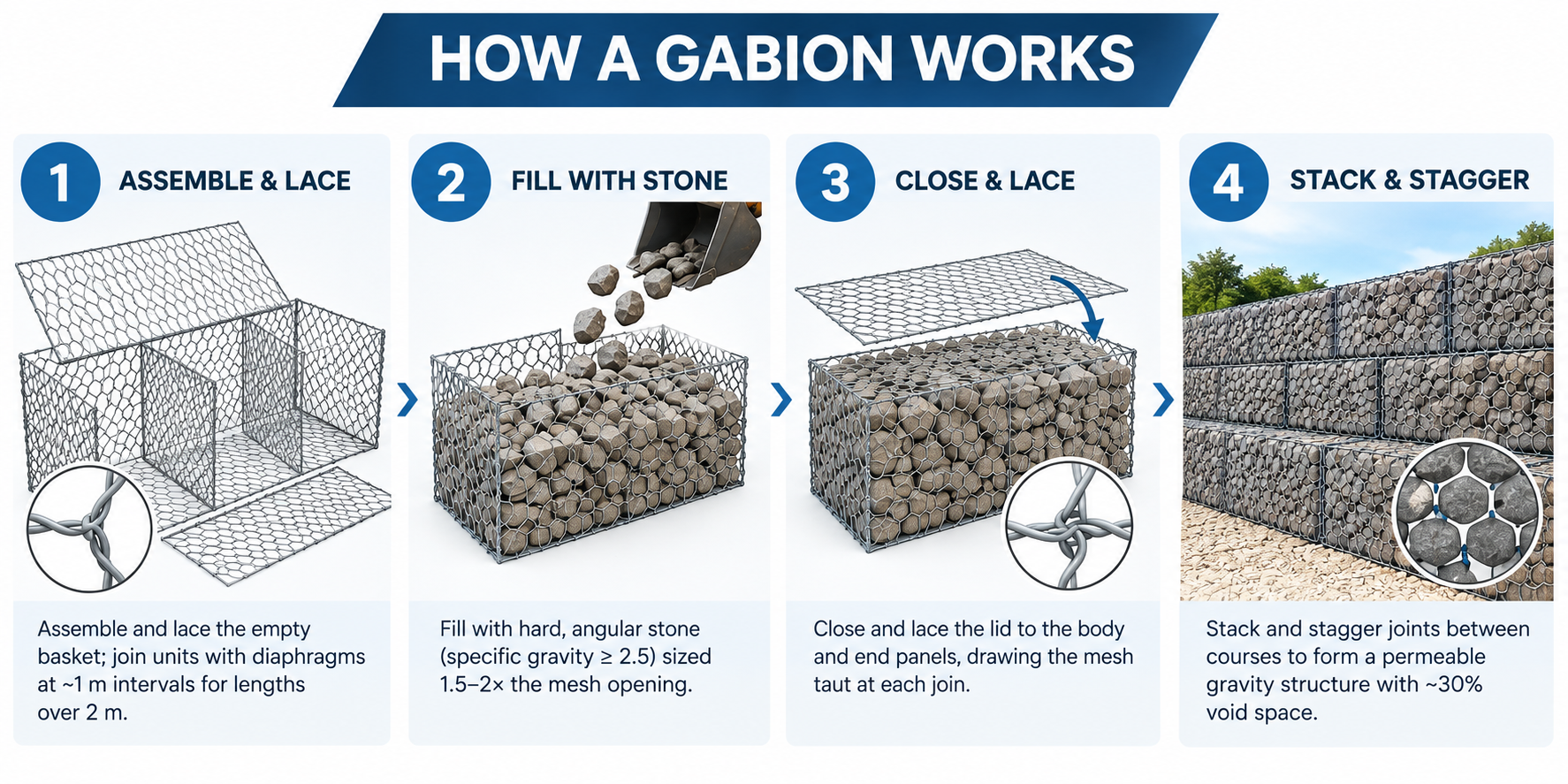
The Gabion Box is the standard rectangular basket that most people picture when they hear "gabion" — assembled flat-packed on site, laced together, then hand-filled with stone. Internal diaphragms divide longer units into cells at roughly 1 m intervals, keeping the stone fill evenly distributed and the structure square as it's built.
Because the full basket depth carries the load, the Gabion Box is the variant built for standalone gravity structures — where the weight of the stone-filled unit itself is what resists earth or water pressure.
A Tailed Gabion Box is a shallow gabion facing unit where the base mesh continues outward as a single, unjointed sheet — the "tail" — instead of stopping at the back of the box. That tail is laid flat and compacted into successive layers of soil backfill, so the wall's stability comes from the reinforced soil mass behind the face, not from a full-depth stack of stone-filled boxes.
It's a different engineering approach to the same job: where a Gabion Box wall carries its own weight, a Tailed Gabion wall lets the soil do the work and uses far less stone to do it.
A Sack Gabion is the same double-twist mesh formed into a long cylindrical tube instead of a rectangular box, then filled with stone and closed at both ends. With no internal diaphragms or box geometry to assemble, it's the fastest gabion unit to place — laid directly onto the ground or stacked in courses.
That simplicity is the point: sack gabions are historically the earliest gabion form, used wherever speed of deployment matters more than the precision of a formed structure. They ship pre-assembled and folded flat from the factory, with lacing wire supplied separately, and can be filled with stone or geotextile-encased sand directly at site — including for underwater placement, where box assembly isn't practical.

Where a Gabion Box is built to retain, a Mattress is built to armour. It's the same mesh and stone fill formed into a wide, shallow panel — typically 170–300 mm thick but several metres wide and long — laid flat across a channel bed, riverbank or slope to absorb flow energy and hold the surface in place.
The mesh opening is tighter here too — typically 6×8 mm against the 8×10 or 10×12 mm used on a standard box — since a shallow stone layer needs smaller voids to stay put. Internal diaphragms at 1 m intervals, formed by folding a double layer of mesh into the base panel for extra stability while filling, divide the mattress into cells so the thin stone layer can't migrate. A geotextile filter fabric always goes underneath, so water can still drain through while the soil beneath stays put.
Wire tensile strength of 350–550 N/mm² per EN 10223-3. The double-twist weave means a single broken wire cannot unravel the panel, unlike welded mesh.
Hot-dip galvanized to EN 10244-2, with PVC or zinc-aluminium coating options for aggressive marine, industrial or high-moisture environments.
Around 30% void space lets water pass freely through the structure, relieving the hydrostatic pressure that causes solid retaining walls to fail.
Filled with locally sourced stone rather than manufactured materials, and typically costs less to install than equivalent masonry construction.
The mesh tolerates up to 10% elongation without losing strength, allowing the structure to flex with ground movement and differential settlement rather than crack.
A design life of 50–100 years depending on coating and site conditions, backed by decades of field performance on riverbank and highway projects.
Manufactured according to IS 16014:2018 and installed per IRC:SP:116-2018 guidelines for highway and bridge structures, with reference to EN 10223-3 and ASTM A975 for international projects.
| Mesh Type | Double-twisted hexagonal woven wire mesh — non-raveling; a single broken wire cannot unravel the panel |
| Mesh Opening (Type 8×10) | 60 × 80 mm, 80 × 100 mm, 100 × 120 mm (or as per project requirement) |
| Mesh Wire Diameter | 2.0 mm – 3.4 mm (typically 2.7 mm) |
| Selvedge Wire Diameter | 3.4 mm – 4.0 mm — thicker edge wire reinforces panel boundaries and connection points |
| Lacing / Connecting Wire | 2.2 mm dia., supplied at approx. 5–10% of basket weight |
| Wire Tensile Strength | 350 – 550 N/mm², with minimum 10% elongation before failure (EN 10223-3) |
| Coating | Hot-dip galvanized (Class A, EN 10244-2) / Galvanized + PVC Coated / Zinc-Aluminium alloy on request |
| Panel Dimensions | Standard and custom sizes available; diaphragms at ~1 m centres for units over 2 m long |
| Filling Material | Hard, angular natural stone, specific gravity ≥ 2.5, sized 1.5–2× the mesh opening to prevent loss through the mesh |
| Design Life | 50–100 years, depending on coating type and site environment |
| Standards | IS 16014:2018 (BIS/ISI) · IRC:SP:116-2018 · IRC:89-2019 · IRC:056 · EN 10223-3 · ASTM A975 |